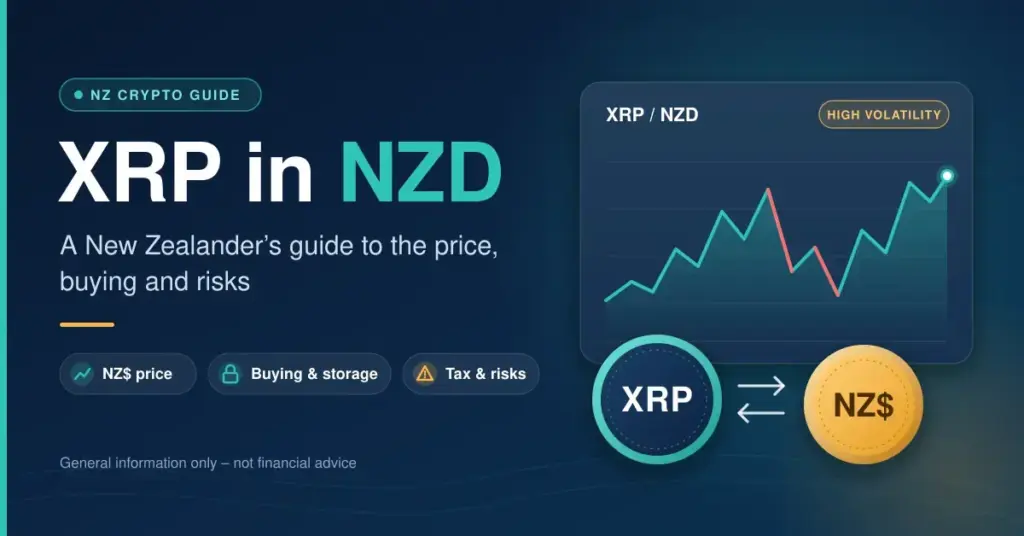

XRP is one of the most widely held and heavily traded crypto assets in the world, and plenty of New Zealanders either own some or keep an eye on its price against the dollar. Before anything else, be clear-eyed about what you are dealing with: crypto is a high-risk, highly volatile and speculative asset class. Prices can swing dramatically in a single day, and you can lose a large part — or all — of the money you put in. This guide explains what XRP actually is, how its price in New Zealand dollars is worked out, how to buy and store it safely here, and the tax rules and risks you should understand first. It sticks to the facts and deliberately avoids hype and price predictions. It is general information only, not financial advice, and not a recommendation to buy XRP or any other crypto asset.
Quick Facts
| Detail | XRP at a glance |
|---|---|
| Asset | XRP (native asset of the XRP Ledger) |
| Launched | 2012, by the founders of Ripple Labs |
| Supply | 100 billion units, all created at launch (no mining) |
| How it settles | Consensus protocol — fast (seconds) and low-cost |
| Main use | Payments-focused crypto asset |
| Legal in NZ? | Yes — owning, buying and selling XRP is legal |
| Tax status in NZ | Treated as property; disposal gains generally taxable as income; outside GST |
| Reporting | CARF applies from 1 April 2026 (platforms report to IRD) |
| Price basis | Priced in USD; the NZD value also depends on the NZD/USD rate |
| Risk level | High — volatile and speculative; you can lose everything |
What XRP is
XRP is a crypto asset native to the XRP Ledger (often shortened to XRPL), a public blockchain designed for fast, low-cost value transfer. A blockchain is a shared digital record of transactions kept in sync across many independent computers, so no single company or bank controls the ledger. XRP was created in 2012 by the developers who went on to found Ripple Labs, a US-based payments company that still uses XRP in some of its products.
Two features set XRP apart from the best-known crypto asset, Bitcoin. First, XRP is not “mined.” Instead of rewarding computers for solving energy-hungry puzzles (a system called proof-of-work), the entire supply of 100 billion XRP was created at launch and released gradually. Second, the XRP Ledger settles transactions using a consensus protocol — a group of independent validators agree on the order of transactions — which makes it quick and cheap to use and far less power-intensive than Bitcoin. In practice a payment on the XRP Ledger typically settles in a few seconds for a tiny fee. For that reason XRP is usually described as a payments-focused asset, whereas Bitcoin is more often framed as a digital store of value. If you want a sense of how a payments-style asset behaves against a store-of-value asset, our guide to the Bitcoin price in NZD is a useful companion read.
A long-running legal cloud over XRP has now largely cleared. In December 2020 the US Securities and Exchange Commission (SEC) sued Ripple, alleging that XRP had been sold as an unregistered security. In July 2023 a federal judge ruled that XRP sold to retail buyers on public exchanges was not a security, while certain institutional sales were. Both sides appealed, but in 2025 they jointly dropped their appeals, leaving the 2023 decision final and ending the case. That removed one major source of legal uncertainty for XRP — but it does nothing to reduce the market and technology risks covered further down.
How XRP’s NZD price works
XRP trades 24 hours a day on exchanges all over the world, and it is overwhelmingly priced in US dollars. That means the price you see in New Zealand dollars is really the product of two moving parts: XRP’s price in USD, and the NZD/USD exchange rate. The practical upshot is that the NZD price of XRP can change even when XRP has not moved at all in US-dollar terms — all it takes is for the Kiwi dollar to strengthen or weaken against the greenback. If you want to understand that second lever, our USD to NZD exchange rate guide explains how and why the pair moves, and a currency converter such as XE (xe.com) will show you the live rate.
To put rough numbers on it: in late 2026 XRP has traded at roughly US$1.40, which — with the New Zealand dollar buying somewhere around 57 US cents — works out to about NZ$2.50. Those figures are illustrative only. XRP reached an all-time high of about US$3.65 in July 2025 (roughly NZ$6.30 at the exchange rate of the time) before falling a long way back. Because crypto prices move by the second, treat any specific number here as a snapshot rather than a fixed value, and always check a live price feed for the current figure before you act on it.
A quick word on price predictions. Online you will find an endless stream of “will XRP hit $10, $100 or $1,000?” content. Nobody can reliably predict a crypto price, and some of those headline targets would imply a market value larger than entire national economies, which is not a serious forecast. Treat all such predictions, however confidently they are stated, as speculation rather than information — and be especially wary of anyone who pairs a price target with a request for your money.
How to buy XRP in New Zealand
Buying XRP in New Zealand is straightforward and legal, and it generally follows the same four steps whichever platform you use:
- Choose an exchange. You can use a New Zealand-based platform, an Australian one that serves NZ customers, or a large global exchange. The comparison below outlines the common options.
- Verify your identity. New Zealand exchanges must follow anti-money-laundering (AML) law, so you will be asked to confirm your identity with a photo ID and sometimes proof of address before you can trade. This is normal and required.
- Deposit New Zealand dollars. Most platforms accept bank transfer; some also take debit or credit cards, though card deposits usually carry higher fees.
- Place your order. Buy the amount of XRP you want at the market price, or set a limit order to buy only at a price you choose. Once the trade settles, the XRP sits in your exchange account until you move it to your own wallet.
Fees matter more than many beginners expect. Watch for the trading fee (a percentage of each buy or sell), any deposit or withdrawal fees, and the spread — the small gap between the buy and sell price that is effectively a hidden cost. A platform advertising a low headline fee can still be more expensive overall once the spread is included, so compare the all-in cost rather than the sticker number.
Where to Buy XRP in NZ
Common ways New Zealanders buy XRP. Fees are indicative only and change often — always confirm the current terms on the platform’s own site. This is an overview, not an endorsement.
| Platform | Base / NZD support | Indicative trading fee | Notes |
|---|---|---|---|
| Easy Crypto | NZ-based; direct NZD deposit & withdrawal | ~0.9% | Beginner-friendly; local support and banking |
| Independent Reserve | Australian; serves NZ, NZD supported | ~0.5% | Simple interface; established exchange |
| Swyftx | Australian; NZD supported | ~0.1–0.6% | FMA-registered; 24/7 support; small withdrawal fee |
| Kraken | Global; NZD deposit options | from ~0.25% | Large global exchange; wide range of assets |
| Binance | Global; NZD via third-party rails | from ~0.1% | Very large exchange; more features, steeper learning curve |
Listing a platform above is not an endorsement of it or of buying XRP — it is simply a factual overview of where New Zealanders commonly trade. Fees and features change often, so confirm the current terms on the platform’s own website before you sign up. Whichever route you choose, start small while you learn how deposits, orders and withdrawals work in practice.
Storing XRP safely

Once you own XRP you have to decide where to keep it. This is one of the most important — and most overlooked — parts of holding crypto, because with digital assets there is no bank to reverse a mistake and no deposit guarantee if something goes wrong. There are three broad options:
- On the exchange. The simplest choice: your XRP stays in your account on the platform you bought it from. It is convenient and fine for small amounts or active trading, but you are trusting the exchange to stay solvent and secure. If it is hacked or fails, your holdings are at risk, and history has several painful examples of exactly that.
- A software (“hot”) wallet. An app on your phone or computer that puts you in control of your own keys while staying connected to the internet. More secure than an exchange for everyday use, but still exposed to malware and phishing.
- A hardware (“cold”) wallet. A physical device such as a Ledger or Trezor that stores your keys offline. For long-term holdings this is widely regarded as the most secure option, because an attacker generally cannot reach keys that never touch the internet.
Whatever you choose, the golden rule of crypto applies: whoever controls the private keys controls the coins. Write down your recovery phrase, store it offline in more than one safe place, and never share it or type it into a website — no legitimate service will ever ask for it. One quirk specific to XRP is the ledger’s base reserve: to keep an XRP wallet (an “account” on the ledger) active you must hold a small minimum that cannot be spent. That reserve was lowered in late 2024 and currently sits at around 1 XRP, so a brand-new wallet needs a little XRP in it just to exist.
Tax and reporting rules in New Zealand
New Zealand does not have a crypto-specific tax regime, but existing tax law still applies — and Inland Revenue (IRD) has been increasingly clear about how. The essentials:
- Crypto is treated as property, not currency. That shapes how gains and losses are taxed.
- Gains on disposal are generally taxable income. New Zealand has no separate capital gains tax, but IRD takes the view that crypto is usually bought with the dominant purpose of resale. So when you sell XRP, swap it for another coin, or use it to buy something, any profit is normally taxable at your marginal income-tax rate, and losses may be deductible. Our New Zealand tax rates guide sets out the income-tax brackets that would apply.
- Crypto is outside the GST net. Legislation passed in 2022 excluded cryptoassets (other than non-fungible tokens) from GST, so buying and selling XRP does not attract GST.
- Keep detailed records. Dates, amounts, NZD values at the time, and fees for every transaction. You need these to work out your tax correctly, and you are legally required to keep them.
A significant change is now in force. From 1 April 2026, New Zealand has adopted the OECD’s Crypto-Asset Reporting Framework (CARF). Local crypto platforms must collect identity and transaction details from their users and report them to Inland Revenue, with the first reports due by 30 June 2027. IRD also exchanges this information with tax authorities overseas, so activity on offshore exchanges is increasingly visible too. In short, the assumption that crypto trading is invisible to the tax office no longer holds. You can read the official guidance on Inland Revenue’s cryptoasset pages at ird.govt.nz/cryptoassets, and if your situation is at all complex it is worth talking to an accountant who understands crypto.
The risks you need to understand
XRP sits firmly at the high-risk end of the investing spectrum. The main risks are worth spelling out plainly:
- Extreme volatility. XRP can move 10–50% in a matter of days, and as noted it currently trades well below its 2025 peak. Sharp falls are a normal feature of this asset, not an anomaly.
- Regulatory risk. Even with the SEC case resolved, crypto rules are still evolving in New Zealand and worldwide. New rules, restrictions or tax changes could affect XRP’s value or how you can use it.
- Counterparty and custody risk. Exchange hacks, platform collapses, or simply losing your own private keys can all mean losing your holdings permanently. There is no depositor protection and no one to appeal to.
- Scams and fraud. Crypto attracts fake “giveaways,” impostor support accounts, romance and investment scams, and bogus trading platforms. The Financial Markets Authority (FMA) regularly warns about these, and you can read its guidance at fma.govt.nz. If an offer is urgent, guaranteed or too good to be true, it is almost certainly a scam.
- No income. Unlike a dividend share or a term deposit, simply holding XRP pays you nothing. Any return depends entirely on selling it later for more than you paid.
The practical takeaways from all of this are the same ones that apply to any speculative asset: only invest money you can genuinely afford to lose, keep crypto to a small slice of a wider plan, and never treat a forecast as a fact.
Who XRP might — and might not — suit
XRP is a fast, low-cost, payments-focused crypto asset with genuine institutional interest and, now, far less legal uncertainty than it had a few years ago. As an investment, though, it remains speculative and volatile. It may appeal to someone who already understands crypto, has a secure way to store it, can stomach big swings in value, and is deliberately allocating a small, loss-tolerant portion of their money to higher-risk assets. It is a poor fit for anyone investing money they will need soon, anyone relying on it to fund a goal like a house deposit or retirement, or anyone who would be seriously harmed by losing the lot.
For most people building long-term wealth, the heavy lifting is done by diversified, lower-risk options rather than by individual crypto assets. Broad index funds and KiwiSaver funds spread your money across hundreds of companies, and beginner-friendly platforms covered in our guide to investing in New Zealand make them easy to access. If crypto has a place at all, it is usually as a small, consciously sized slice on top of that foundation — not the foundation itself.
Important disclaimer
This article is general information about XRP for New Zealanders. It is not financial advice, and it is not a recommendation to buy, sell or hold XRP or any other crypto asset. Cryptocurrency is a high-risk, highly volatile and speculative investment, and you can lose some or all of your money. Any prices mentioned are illustrative snapshots only — check a live feed for the current rate before acting. Crypto’s tax treatment depends on your individual circumstances; keep full records and confirm your position with Inland Revenue or a qualified accountant. Before investing, consider getting advice from a licensed financial adviser, and read the independent guidance from the Financial Markets Authority and from Sorted (sorted.org.nz), New Zealand’s free money-guidance service, on how to weigh up high-risk investments.
Sources
- Inland Revenue — tax on cryptoassets
- Inland Revenue — Crypto-Asset Reporting Framework (CARF) overview
- Financial Markets Authority — cryptocurrencies and investor warnings
- Sorted — guides to investing and high-risk investments
- XRP Ledger — accounts and base reserve requirements
- CoinGecko — XRP live price, market cap and all-time high
- Reuters — SEC and Ripple drop appeals, ending the XRP case
Frequently asked questions
What is XRP?
XRP is a crypto asset native to the XRP Ledger, created in 2012 by the developers behind Ripple Labs and designed for fast, low-cost cross-border payments. Unlike Bitcoin it is not mined — all 100 billion units were created at launch — and it settles transactions through a consensus protocol rather than energy-heavy proof-of-work. It is generally described as payments-focused, in contrast to Bitcoin’s store-of-value framing.
How do I buy XRP in New Zealand, and what is it worth?
Use an NZ-friendly exchange such as Easy Crypto, Independent Reserve or Swyftx, or a major global exchange: verify your identity under AML rules, deposit New Zealand dollars, and place an order. On price, XRP has traded around NZ$2.50 in late 2026, but crypto moves constantly and the NZD figure also depends on the exchange rate, so always check a live price feed for the current number.
Do I have to pay tax on XRP in New Zealand?
Usually, yes. Inland Revenue treats crypto as property, and profit from selling, swapping or spending XRP is generally taxable as income at your marginal rate — there is no separate capital gains tax, but disposal gains are normally taxable, and losses may be deductible. Crypto is outside GST. Keep detailed records, and note that from 1 April 2026 New Zealand platforms report your activity to IRD under the CARF rules.
How should I store XRP safely?
For long-term holdings, a hardware (“cold”) wallet such as a Ledger or Trezor is the most secure option because it keeps your keys offline and under your control. Software wallets suit regular use, while leaving XRP on an exchange is convenient but exposes you to exchange-hack and platform-failure risk. Keep your recovery phrase offline and never share it, and remember an XRP wallet needs a small base reserve (currently about 1 XRP) to stay active.
Is XRP a good investment?
That depends entirely on your risk tolerance, and it is genuinely high-risk. XRP is volatile — it can move 10–50% in days and currently sits well below its 2025 peak — exposed to regulatory and technology risk, and offers no protection if an exchange fails or you lose your keys. Only consider it with money you can afford to lose, as a small part of a diversified plan, and never rely on price predictions.