The living wage is the hourly rate calculated as what a worker and their family need to meet life’s basic necessities, live with dignity and take part in their community. Unlike the minimum wage — the legal floor set by the Government — the living wage is a voluntary benchmark based on real living costs, so only employers who choose to pay it are bound by it. This guide explains the current rate, how it is worked out, how it differs from the minimum wage, who pays it and what it means for your pay packet. It is general information, not financial advice.
Key facts
- Current rate (2026/27): $29.90 per hour, effective 1 September 2026
- Previous rate (2025/26): $28.95 per hour
- Full-time (40 hrs): about $1,196 gross a week, roughly $62,192 a year
- Calculated by: Family Centre Social Policy Research Unit
- Released by: Living Wage Movement Aotearoa New Zealand
- Status: voluntary benchmark (not law)
- Accredited employers: around 340, covering more than 64,000 workers
- Updated: every year on 1 September; full methodology review due 2028
The current living wage rate (2026/27)
For the 2026/27 year, the New Zealand living wage is $29.90 an hour, effective from 1 September 2026. That is a 95-cent rise on the $28.95 rate that applied in 2025/26. The figure is published each year by Living Wage Movement Aotearoa New Zealand (livingwage.org.nz), the coalition that runs the campaign, and it reports that more than 64,000 workers are covered by employers who have committed to pay it.
Because it is a voluntary standard rather than a law, the living wage is best thought of as a target that a growing group of employers choose to meet. There is no penalty for an employer who pays less — provided they still meet the compulsory minimum wage — but accredited employers accept annual checks to prove they are paying at least the current rate.
What the headline rate means week by week
Hourly figures can be hard to picture, so it helps to translate the rate into the pay cycles most people are actually paid on. At a standard 40-hour week, $29.90 an hour works out to roughly:
- Per day (8 hours): about $239.20 gross
- Per week (40 hours): about $1,196 gross
- Per fortnight (80 hours): about $2,392 gross
- Per year (full-time): about $62,192 gross before tax
These are gross figures — the amount before income tax, ACC levies and any KiwiSaver contributions come out. What actually lands in a bank account is lower, which is why it is worth checking your take-home pay separately rather than assuming the hourly rate is what you keep.
How the living wage is calculated
The figure is worked out independently by the Family Centre Social Policy Research Unit on behalf of the Living Wage Movement. Rather than being a political or negotiated number, it starts from evidence about what a typical household actually needs to get by in New Zealand, and it is designed to be transparent and repeatable from one year to the next.
The reference household
The calculation is built around a specific reference family: two adults and two children, with one adult working full-time (about 40 hours a week) and the other working part-time (about 20 hours). The living wage is the hourly rate those two incomes would need to reach so the household can cover its costs without going into hardship. This single assumed household is one of the method’s strengths — it is consistent and easy to understand — but also one of the most common points of debate, because real households vary enormously.
What costs it covers
The researchers price a realistic basket of what it takes to live, not merely to survive. That includes the obvious essentials — housing, food, power, transport, childcare and healthcare — plus a modest allowance for the things that let a family take part in the community rather than simply exist, such as a small amount for recreation, savings and unexpected costs. The idea of “participation” is central to the concept: the living wage is meant to reflect dignity, not a bare subsistence floor.
Annual adjustment and the five-year review
A full methodology review — a ground-up re-pricing of the household’s costs — happens every five years, with the next review due in 2028. In the years between those reviews, the rate is adjusted using Stats NZ’s movement in average ordinary-time hourly earnings (stats.govt.nz), so it keeps pace with how wages across the economy are moving. A new rate is announced each year and takes effect on 1 September, which is why it moves on a different timetable from the minimum wage.
Living wage versus the minimum wage
The two are often confused, but they are set by different bodies, on different timetables, for different purposes. The minimum wage is the legal floor almost every employer must pay, set annually by the Government (employment.govt.nz) after a review by the Ministry of Business, Innovation and Employment. The living wage is a voluntary, cost-of-living-based benchmark that only accredited employers commit to. The table below sets the two side by side.
Living wage vs minimum wage
| Feature | Living wage | Minimum wage |
|---|---|---|
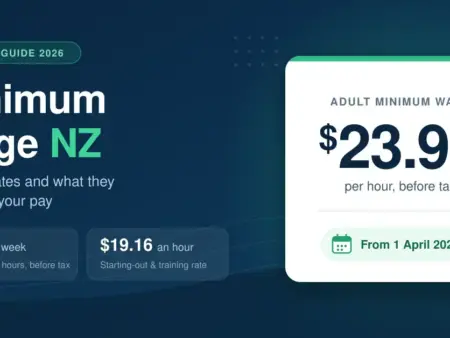
| Rate (2026) | $29.90 / hour (from 1 Sep 2026) | $23.95 / hour adult (from 1 Apr 2026) |
| Legal status | Voluntary benchmark | Legal requirement |
| Set by | Family Centre Social Policy Research Unit, released by Living Wage Movement Aotearoa NZ | New Zealand Government (annual MBIE review) |
| Based on | Real cost of living for a reference family | Government decision weighing several factors |
| Who must pay it | Only accredited employers (about 340) | Almost all employers |
| Updated | Annually, on 1 September | Annually, on 1 April |
| Other rates | Single national rate | Starting-out and training rate $19.16 / hour |
Why the gap matters
As of 2026 the gap is close to $6 an hour: $29.90 against the adult minimum of $23.95 (with a starting-out and training rate of $19.16, set at 80% of the adult rate for eligible younger or newly trained workers). Over a full-time year that difference is roughly $12,400 in gross pay. That gap is the reason the movement exists — it illustrates that someone on the legal minimum can still fall short of what independent researchers estimate it costs to live decently, particularly in higher-cost cities. For a fuller breakdown of the statutory floor, who it applies to and how it is reviewed, see our guide to the minimum wage in New Zealand.
A short history of the living wage in New Zealand
The campaign launched in 2012, and the first New Zealand living wage rate — $18.40 an hour — was set in 2013. Since then the rate has been recalculated and re-announced every year, climbing steadily as living costs and average earnings have risen. The move to $29.90 in 2026/27 means the rate has grown by well over half since it began, tracking the sharp increases in housing and everyday costs that New Zealand households have faced over the same period. Each annual increase is published openly, which lets workers, employers and researchers see how the number has moved over time rather than treating it as a one-off figure.
The Living Wage Movement and accredited employers
Living Wage Movement Aotearoa New Zealand is a coalition of unions, faith-based organisations and community groups, and it is not aligned to any political party. Its central tool is accreditation: a public, verifiable commitment by an employer to pay the living wage.
How accreditation works
Employers can become accredited Living Wage Employers by committing to pay the current rate to all of their directly employed staff, and — importantly — to the workers who deliver their regular contracted services, such as cleaners and security staff employed through outside contractors. Accreditation is checked annually: because the rate rises each September, an employer has to keep lifting pay to stay accredited rather than qualifying once and stopping. That ongoing verification is what gives the badge its meaning.
Who pays the living wage
Around 340 organisations are accredited, spanning a broad mix of sectors: local government (Auckland Council has paid it since 2017), universities, healthcare providers, churches and charities, and a range of private businesses including several large employers. Many more organisations pay at or above the rate without formally accrediting. For a worker, the practical point is that being paid the living wage and working for an accredited employer are two separate things — a business can pay the rate without the badge, and the Movement publishes a searchable list of the employers that do hold accreditation.
How to check whether you earn the living wage
You do not need the Movement’s permission to compare your own pay with the benchmark — it only takes a little arithmetic.
Working out your hourly rate
If you are salaried, divide your annual salary by 52 to get a weekly figure, then divide that by your usual weekly hours. If you are paid weekly, simply divide your weekly pay by the hours you work. For example, $60,000 a year over a 40-hour week is about $28.85 an hour — just under the current $29.90 living wage. Someone on $62,200 for the same hours would be right on it. To put any hourly figure in the context of what roles typically pay, our overview of typical salaries in New Zealand is a useful reference point.
Turning gross pay into take-home pay
Comparing to the living wage tells you about your gross rate, but your spending power depends on what you keep after tax. To see how any gross wage translates into net pay after income tax, the ACC earners’ levy and KiwiSaver, try our salary calculator and read our tax rates guide for the brackets that apply. If money is tight regardless of the headline rate, building even a small buffer matters: our budget planner and our savings account guide are practical starting points, and free tools such as Sorted (sorted.org.nz) can help you map where your pay actually goes.
The case for and against
The living wage is a genuine policy debate, not a settled question, and reasonable people land on different sides of it. Understanding both sets of arguments helps you read the headlines critically.
Arguments in favour
Supporters argue that paying the living wage reduces financial stress and hardship for low-paid workers and improves wellbeing. They also point to benefits for employers: research and case studies often associate higher base pay with lower staff turnover, reduced absenteeism, better recruitment, and a stronger reputation with both staff and customers. For organisations that deal directly with the public, the accreditation badge can also be a visible signal of values.
Common criticisms
Critics raise concerns that deserve to be taken seriously. A single national rate does not reflect large regional differences in living costs — housing in Auckland is far dearer than in many provincial towns, so one number can over- or under-shoot depending on where a worker lives. The method also rests on one assumed household type, which may not match a single person or a household with no children. There are flow-on effects too: lifting the base can create wage-compression pressure, because more skilled or senior staff expect to keep a margin above entry-level pay. And ongoing annual increases can fall hardest on small businesses and tight-margin sectors, with potential effects on hiring and hours. These tensions — fair pay against cost pressures — are precisely why the living wage remains a voluntary benchmark while the Government sets the compulsory minimum wage separately.
What it means for workers and employers
For a worker, the living wage is a useful yardstick: it tells you whether your pay is keeping up with an independent estimate of what it costs to live decently, and it gives you a concrete figure to raise in a pay conversation. For an employer, it is a decision about positioning and cost — whether to accredit, pay the rate informally, or stay at the market level — weighed against the retention, reputation and morale effects. For a consumer, the Movement’s employer list is one of the few public signals of how an organisation treats its lowest-paid staff, which some people choose to factor into where they spend.
The bottom line
The living wage is a research-based estimate of what it takes to live with dignity in New Zealand: $29.90 an hour for 2026/27, close to $6 above the adult minimum wage. It is voluntary, paid by a growing group of accredited employers, calculated around a reference family’s real costs, and updated every 1 September. Whether you are checking your own pay, an employer weighing accreditation, or a consumer choosing where to spend, knowing the rate and how it works helps you make an informed decision — just remember to confirm the latest figure before you rely on it, because it changes every year.
Disclaimer
This article is general information about the New Zealand living wage, not financial advice. The living wage is a voluntary benchmark, not a legal requirement — the compulsory minimum wage is set separately by the Government. Rates change annually (the living wage on 1 September, the minimum wage on 1 April), so the figures here — current as at October 2026 — should be confirmed against the latest published rates before you rely on them. For the current rate see Living Wage Movement Aotearoa (livingwage.org.nz); for the minimum wage see Employment New Zealand (employment.govt.nz).
Sources
- Living Wage Movement Aotearoa NZ — 2026/27 living wage rate ($29.90)
- Living Wage Movement Aotearoa NZ — accredited employers
- Employment New Zealand — current minimum wage rates
- MBIE — minimum wage set for 2026 ($23.95)
- Family Centre Social Policy Research Unit
- Stats NZ — average ordinary-time hourly earnings
Frequently asked questions
What is the living wage in NZ right now?
For the 2026/27 year the New Zealand living wage is $29.90 an hour, effective from 1 September 2026 (up from $28.95 the year before). It is the hourly rate independently calculated as what a worker and their family need to meet basic living costs and take part in society, and it is a voluntary benchmark rather than a legal requirement.
Who sets the living wage, and is it mandatory?
It is calculated by the Family Centre Social Policy Research Unit and released by Living Wage Movement Aotearoa New Zealand. It is not mandatory — only employers who choose to become accredited Living Wage Employers commit to paying it. The Government separately sets the compulsory minimum wage that almost all employers must pay.
What is the difference between the living wage and the minimum wage?
The minimum wage ($23.95 an hour for adults from 1 April 2026) is the legal floor almost all employers must pay. The living wage ($29.90 an hour from 1 September 2026) is a voluntary, cost-of-living-based benchmark set by an independent body. In 2026 the living wage is close to $6 an hour higher than the adult minimum wage.
How is the living wage calculated?
It is based on a reference household of two adults and two children (one working full-time, one part-time) and the real cost of essentials such as housing, food, transport, childcare and healthcare, plus a small allowance to participate in the community. The methodology is fully reviewed every five years, and in the years between it is adjusted in line with Stats NZ’s average ordinary-time hourly earnings.
How do I know if I am earning the living wage?
Work out your hourly rate — annual salary divided by 52 and then by your weekly hours, or weekly pay divided by hours worked — and compare it to the current $29.90 figure. For example, $60,000 a year over 40 hours a week is about $28.85 an hour, just under the living wage. Whether your employer is accredited is a separate check on the Living Wage Movement’s employer list.