New Zealand runs a progressive income tax system: your income is divided into bands, and each band is taxed at its own rate, so you only ever pay a higher rate on the portion of income above each threshold. Knowing the current rates matters whether you earn a salary, pick up a second job, contract for yourself, or invest through a fund. This guide covers the income tax brackets for the 2026–27 tax year, how PAYE works, the ACC earners’ levy, secondary tax, PIE investment tax and the credits and deductions that shape your take-home pay. It is general information, not tax advice — confirm your own situation with Inland Revenue (IRD) or a registered tax agent.
NZ income tax brackets (2026–27)
New Zealand’s tax year runs from 1 April to 31 March. For 2026–27 there are five marginal rates, and they are unchanged from 2025–26 — the thresholds were last lifted on 31 July 2024, so any older figures built around the $14,000 / $48,000 / $70,000 bands are out of date. Inland Revenue publishes the official rates at ird.govt.nz.
Income tax brackets
| Taxable income (2026–27) | Marginal rate | Tax within this band |
|---|---|---|
| $0 – $15,600 | 10.5% | up to $1,638 |
| $15,601 – $53,500 | 17.5% | up to $6,632.50 |
| $53,501 – $78,100 | 30% | up to $7,380 |
| $78,101 – $180,000 | 33% | up to $33,627 |
| $180,001 and over | 39% | 39% of the excess |
Each rate applies only to the income that falls within its band, not to your whole income.
The rate in your top band is your marginal rate — the tax on your next dollar earned — not the rate on your whole income. That distinction catches a lot of people out, so it is worth seeing how it plays out in practice.
How marginal tax really works
Because the bands stack, your effective (average) rate is always lower than your top rate. Someone earning $60,000 sits in the 30% band, but pays roughly $10,220 of income tax across all four lower bands — an effective rate of about 17%, not 30%. On $100,000, the top marginal rate is 33%, but only the slice above $78,100 is taxed at 33%; the total tax is about $22,878, an effective rate of roughly 23%.
The practical upshot: a pay rise never leaves you worse off overall, because the higher rate only ever applies to the extra income above a threshold. It also means two people on very different salaries can have surprisingly similar effective rates once the lower bands are counted. For a step-by-step breakdown with more worked numbers, see our guide to how income tax is calculated.
PAYE and your tax code
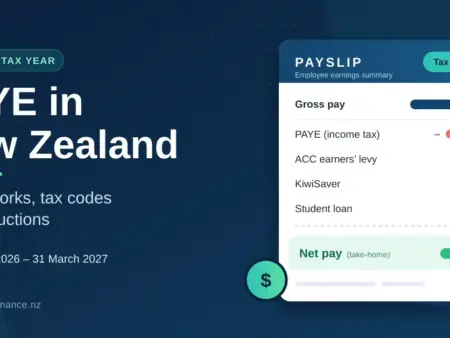
If you are an employee, you pay tax through PAYE (Pay As You Earn): your employer works out the tax on each pay and sends it to IRD, so most wage and salary earners never have to file a return. The amount deducted depends on your tax code (for example M for your main job, or ME if you also claim a tax credit). Using the wrong code — especially after changing jobs or taking a second income — is one of the most common reasons people end up with a bill or a refund at year end.
Some earners between $24,000 and $70,000 a year also qualify for the Independent Earner Tax Credit (IETC) — up to $520 a year ($10 a week), abating above $66,000 — provided they are not on a main benefit or receiving Working for Families. You can check your exact deductions with our PAYE calculator guide.
The ACC earners’ levy
On top of income tax, a flat ACC earners’ levy funds cover for injuries, whether they happen at work or not. For the 2026–27 year it is 1.75% of liable earnings up to a cap of $156,641 (a maximum of about $2,741 a year), up from 1.67% the previous year. It is deducted automatically alongside PAYE and is separate from income tax, but it still reduces your take-home pay. The current rate is set out at acc.co.nz.
Secondary tax and more than one income
If you have a second job or another regular income, that source uses a secondary tax code (such as SB, S, SH, ST or SA, matched to your total income). Many people assume this means a second job is “taxed more,” but it is not a penalty: the code simply applies the right marginal rate to that income during the year so you are not left underpaying. Your total tax is always based on your total income, and IRD reconciles any difference at year end. If your codes do not match your real total income, you can apply to IRD for a tailored tax code so your deductions are closer to correct from the start.
Contractors, self-employment and provisional tax
If you work for yourself — as a contractor, freelancer or sole trader — nobody deducts PAYE for you, so the tax is yours to manage. In your first year you usually pay the tax on that income as a lump sum after filing, and once your residual tax passes $5,000 you move onto provisional tax: you pay it in instalments during the year (commonly three) as an estimate of what you will owe, which is then squared up when you file. Some contractors on a schedular payment do have tax withheld at source, but most need to set money aside themselves — a rough rule of thumb is to park around a third of each payment for tax and ACC. The self-employed also pay their ACC levies separately, invoiced directly by ACC rather than taken out of pay. The brackets are identical to those for employees; what changes is who handles the paperwork, and when.
Investment income: PIE tax and your PIR
Money you invest through a KiwiSaver scheme or a managed fund is usually taxed inside the fund as a Portfolio Investment Entity (PIE) at your Prescribed Investor Rate (PIR). The key advantage is that the PIR is capped at 28%, even if your income-tax rate is 33% or 39%. Your PIR is based on your income over the previous two years, and for resident individuals there are three rates:
- 10.5% — lower incomes (taxable income up to about $15,600)
- 17.5% — middle incomes (up to about $53,500)
- 28% — everyone above that (the cap)
Getting your PIR right matters. Set it too low and you will owe tax at year end; set it too high and — unlike most overpayments — you may not get the difference back. You can confirm yours at ird.govt.nz/pir, and our investing guide explains where PIE tax fits into a portfolio.
Your take-home pay
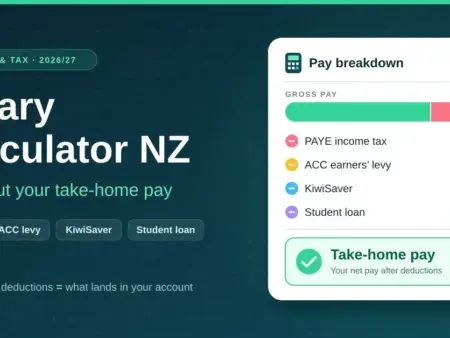
Income tax, the ACC levy and KiwiSaver all come out before the money reaches your account, so it helps to see them stacked up on a real salary. The example below uses a $80,000 gross income with the default 3.5% KiwiSaver rate.
Take-home pay example
| Component (on $80,000 gross) | Amount |
|---|---|
| Gross salary | $80,000 |
| Income tax | − ~$16,278 |
| ACC earners’ levy (1.75%) | − ~$1,400 |
| KiwiSaver (3.5%) | − ~$2,800 |
| Take-home (approx.) | ~$59,500/yr |
That is roughly $1,145 a week. Exact amounts vary with your tax code, KiwiSaver rate, student loan and other circumstances.
Your own figure will differ with your tax code, KiwiSaver rate, any student-loan deduction and whether you claim the IETC — but the shape of it holds: most of the gap between gross and net is income tax, with the levy and savings on top.
KiwiSaver, student loan and GST
A few other deductions and taxes round out the picture:
- KiwiSaver: your contributions come out of pay that has already been taxed, so they are not taxed again; your employer’s contributions are taxed via ESCT. The default employee rate rose to 3.5% from 1 April 2026 (and is set to reach 4% from 1 April 2028), with 4%, 6%, 8% and 10% also available. The annual government contribution is now 25c for every $1 you put in, up to $260.72. See our KiwiSaver guide for the detail.
- Student loan: if you have one, repayments are deducted at 12% of income above the annual threshold ($24,128 for 2026–27), using an SL tax code.
- GST: separate from income tax, a 15% Goods and Services Tax applies to most things you buy; our GST calculator explains how it is added and backed out.
- Interest and dividends: interest from a bank account or term deposit is taxed through Resident Withholding Tax (RWT) at the rate you nominate to match your income tax band (10.5%, 17.5%, 30%, 33% or 39%). Give your bank the correct rate and your IRD number, or it defaults to the top rate.
Resident vs non-resident
If you are a New Zealand tax resident, you pay tax on your worldwide income. If you are a non-resident, you pay tax only on income with a New Zealand source, and some income types carry different withholding rates. Residency depends on the days you spend in the country, whether you have a permanent place of abode here, and IRD’s determination — so if you are moving to or from New Zealand, it is worth confirming your status with IRD rather than assuming.
Common tax mistakes to avoid
Most tax errors are simple and avoidable:
- Believing all your income is taxed at your top rate — only the portion above each threshold is.
- Using the wrong tax code, especially after a job change or with a second income.
- Forgetting the ACC levy and KiwiSaver reduce take-home pay.
- Setting the wrong PIR on fund investments.
- Contractors treating income like a salary — they generally pay provisional tax, not PAYE, and need to set money aside.
- Ignoring student-loan deductions or not updating IRD when circumstances change.
Getting your tax code and PIR right upfront prevents most of them. For related reading, see our guides to the average salary in New Zealand and the minimum wage.
Disclaimer
This article is general information about tax rates in New Zealand, not tax or financial advice. Rates, thresholds and levies are set by law and change over time — the figures here reflect the 2026–27 tax year. Always confirm current figures and your own obligations with Inland Revenue or a registered tax agent before acting. For free, plain-language help with budgeting and money decisions, the government-backed sorted.org.nz is a good starting point.
Sources
Frequently asked questions (FAQ)
What are the income tax rates in NZ for 2026–27?
There are five progressive brackets, unchanged from 2025–26: 10.5% on income up to $15,600; 17.5% from $15,601 to $53,500; 30% from $53,501 to $78,100; 33% from $78,101 to $180,000; and 39% above $180,000. You pay each rate only on the income within that band.
How does the progressive system work — is a pay rise worth it?
Yes. Higher rates apply only to the income above each threshold, so moving into a new bracket never reduces your overall take-home pay. Your effective (average) rate stays well below your top marginal rate — around 17% on $60,000, for example.
What is the ACC earners’ levy?
It is a flat levy that funds accident cover, currently 1.75% of earnings up to a cap of $156,641 for 2026–27. It is deducted automatically with PAYE and is separate from income tax, but it reduces your take-home pay.
Do I pay more tax if I have two jobs?
No. A secondary tax code applies the correct rate to your second income during the year so you do not underpay, but your total tax is based on your total income and IRD reconciles any difference at year end. It is withholding timing, not an extra charge.
Are NZ tax rates changing?
The income tax brackets are frozen — 2026–27 matches 2025–26, and they were last changed on 31 July 2024. The ACC levy rose to 1.75% and the default KiwiSaver employee rate rose to 3.5% from 1 April 2026, so always check the current figures with IRD.