Use our NZ salary calculator guide to understand your take-home pay after PAYE, ACC, and KiwiSaver. Includes median salary benchmarks, Hilary Barry salary context, and practical tips.

Salary Calculator NZ: Work Out Your Take-Home Pay

A salary calculator turns a gross pay figure into the number that actually matters to your day-to-day life: what lands in your bank account after tax and the other deductions have been taken out. In New Zealand the gap between gross and net can run to tens of thousands of dollars a year, because PAYE income tax, the ACC earners’ levy, KiwiSaver and any student loan repayment are all removed before you see your pay. This guide explains exactly how a salary calculator works, which figures to enter, and how to read the result — with current 2026/27 numbers and worked examples. It is general information about pay and tax in New Zealand, not financial advice.
How PAYE tax works
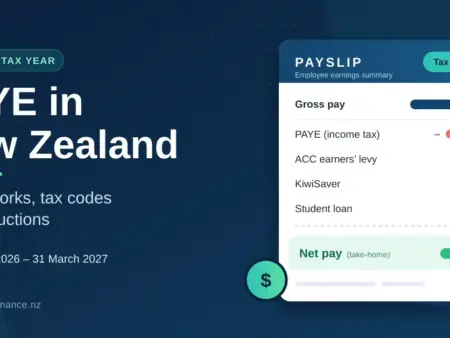
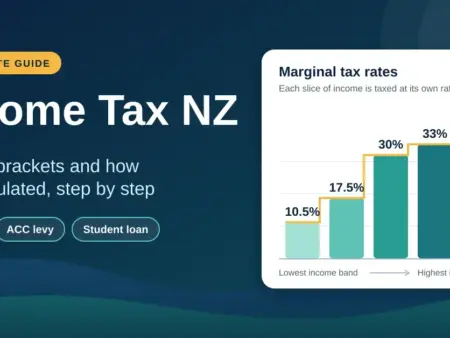
New Zealand runs a Pay As You Earn (PAYE) system, which means your employer deducts income tax from every pay before it reaches you, rather than you paying it in a lump sum at year end. Income tax is charged on a progressive scale: the country is divided into tax bands, and each slice of your income is taxed at the rate for that band. A higher rate only ever applies to the income above a threshold — never to your whole salary.
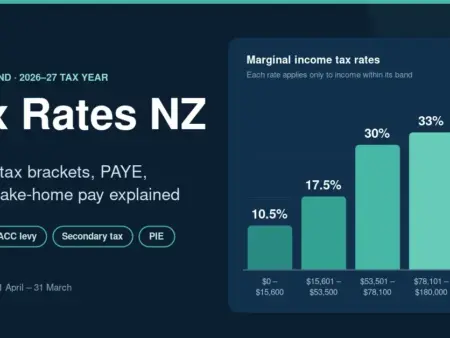
That single point is the reason a salary calculator is so useful, and why so many people overestimate their tax. Someone on $80,000, for example, sits in the 33% band, but pays 33% only on the roughly $1,900 earned above $78,100 — the rest is taxed at the lower rates below. The thresholds below have applied since 31 July 2024 and are unchanged for the 2026/27 tax year.
NZ PAYE tax brackets (2026/27)
| Taxable income | Tax rate (2026/27) |
|---|---|
| $0 – $15,600 | 10.5% |
| $15,601 – $53,500 | 17.5% |
| $53,501 – $78,100 | 30% |
| $78,101 – $180,000 | 33% |
| Over $180,000 | 39% |
Each rate applies only to the income within that band. There is no tax-free threshold. Rates and thresholds are unchanged for the 2026/27 tax year.
There is no tax-free threshold in New Zealand: tax applies from the first dollar you earn. A calculator applies each of these rates automatically, so you do not have to work the bands out by hand. For a fuller breakdown of the bands and how they are applied, see our NZ tax rates guide, and for the tax calculation on its own our PAYE calculator guide.
The other deductions that come off your pay
Income tax is only part of the story. Three further items commonly reduce your take-home pay, and a good salary calculator accounts for all of them:
- ACC earners’ levy. This funds cover for injuries that happen outside work. From 1 April 2026 the levy is 1.75% of your gross earnings (up from 1.67%), charged up to a maximum of $156,641 of income — so the most anyone pays in 2026/27 is about $2,741 for the year. It is deducted through PAYE alongside your income tax.
- KiwiSaver. If you are an active member, your contribution is a percentage of your gross pay. From 1 April 2026 the default minimum employee rate rose from 3% to 3.5%, and you can choose 3.5%, 4%, 6%, 8% or 10%. Members who find the higher minimum a stretch can apply to Inland Revenue for a temporary reduction back to 3% for between 92 days and a year. Your employer pays a matching contribution on top of your salary.
- Student loan. If you have a New Zealand student loan, repayments are deducted at 12% of every dollar you earn above the repayment threshold, which is $24,128 a year for 2026/27 (about $464 a week or $928 a fortnight). The threshold is applied each pay period, so part-year or variable earnings are handled automatically.
Because these three items vary from person to person, the single most important thing when you use a salary calculator is to enter your actual KiwiSaver rate and student loan status. Leave them at the wrong setting and your net figure will be off, sometimes by thousands of dollars a year.
Using a salary calculator, step by step
Most New Zealand salary calculators ask for a small set of inputs and then do the rest:
- Gross salary or hourly rate. Good calculators convert freely between annual, monthly, fortnightly, weekly and hourly figures, so you can enter whichever one your offer or payslip uses.
- Pay frequency. Weekly, fortnightly or monthly — this sets how the result is broken down.
- KiwiSaver rate. Your chosen contribution percentage, or 0% if you have opted out or taken a savings suspension.
- Student loan. Whether you are repaying one, so the 12% deduction is applied above the threshold.
- Tax code. The code that tells payroll how much tax to withhold.
Most employees with a single main job use the M tax code. If your annual income is between $24,000 and $70,000 and you do not receive Working for Families, a main benefit or NZ Super, you may qualify for the Independent Earner Tax Credit (IETC) — worth up to $520 a year — by using the ME code. You get the full $520 up to $66,000, after which it reduces by 13 cents for every dollar you earn, reaching zero at $70,000. If you have a second job or other income, that income needs a secondary tax code (SB, S, SH, ST or SA) chosen on your total earnings, so the right amount of tax is withheld across both. Once your inputs are in, the calculator returns your net pay per period together with total tax, the ACC levy and your KiwiSaver deduction — figures always worth cross-checking against a real payslip, because tax-code mistakes do happen.
Gross vs net: what actually matters for budgeting
One of the most common money mistakes is building a budget around gross salary rather than the net pay you actually receive. The difference is not small. The table below shows indicative take-home pay at a range of salaries for 2026/27, on the M tax code with a 3.5% KiwiSaver contribution and no student loan.
Take-home pay examples (2026/27)
Indicative annual take-home pay on the M tax code, with a 3.5% KiwiSaver contribution and no student loan. Figures are rounded and for guidance only.
| Gross salary | PAYE income tax | ACC levy (1.75%) | KiwiSaver (3.5%) | Net per year | Net per fortnight |
|---|---|---|---|---|---|
| $50,000 | $7,658 | $875 | $1,750 | $39,717 | $1,528 |
| $70,000 | $13,221 | $1,225 | $2,450 | $53,105 | $2,043 |
| $90,000 | $19,578 | $1,575 | $3,150 | $65,698 | $2,527 |
| $120,000 | $29,478 | $2,100 | $4,200 | $84,223 | $3,239 |
| $200,000 | $57,078 | $2,741 | $7,000 | $133,181 | $5,122 |
At $200,000 the ACC levy is capped because only the first $156,641 of income is charged. Add a student loan and 12% of income above $24,128 would be deducted on top.
Take a $90,000 role. After PAYE and the ACC levy your take-home is roughly $68,800 a year, and after a 3.5% KiwiSaver contribution about $65,700 — a gap from gross of more than $24,000, which materially changes the rent or mortgage you can realistically service. Lenders assess your borrowing capacity on your gross income, but you actually repay a loan out of your net pay, so both numbers matter — build any budget or repayment plan around the net figure before you commit to anything.
Benchmarking your pay against New Zealand wages
Knowing whether a gross salary is competitive gives you a stronger position when you negotiate. According to Stats NZ’s Labour Market Statistics for the June 2026 quarter, median weekly earnings from wages and salaries were $1,419 — about $73,800 a year annualised — up 2.8% on a year earlier, while full-time median hourly earnings were $38.00. Pay varies a great deal by region, industry, age and experience: Auckland and Wellington tend to run higher, provincial areas lower. The median is a more honest benchmark than the average, which a small number of very high earners pull upwards. For a deeper look at where you sit, see our guide to the average salary in New Zealand.
At the other end, the adult minimum wage is $23.95 an hour from 1 April 2026 — about $958 before tax for a 40-hour week, or roughly $49,816 a year. The starting-out and training rates sit at $19.16 an hour (80% of the adult rate). Both are reviewed each 1 April; our minimum wage guide covers who each rate applies to.
Hilary Barry salary: what top earners show about the top tax rate
People searching for the Hilary Barry salary are usually curious about what New Zealand’s best-known presenters earn — and what the tax looks like at that level. Hilary Barry is one of the country’s most recognised broadcasters, but TVNZ does not publicly disclose presenter pay, so any specific figure circulating online is speculation rather than confirmed fact.
What can be said factually is that presenters at that level typically earn well into six figures, placing them in the 33% or 39% tax bands. On a $200,000 salary, for instance, you would pay 39% only on the $20,000 above $180,000 — that is $7,800 on the top slice — while your effective tax rate across the whole salary works out at around 28–29%, lower than the top marginal rate because the earlier bands are taxed far less. The broader lesson for anyone, at any pay level, is the same: a headline salary is not what reaches your account, so always compare gross figures like-for-like and run the net through a calculator.
Salary negotiation tips
Understanding your net figure gives you leverage in a pay conversation. A few practical points:
- Work backwards from net. Decide the monthly take-home you need, then calculate the gross salary that produces it — that is the number to ask for.
- Count the full package. Your employer’s KiwiSaver contribution sits on top of salary: a $70,000 role with a 3.5% employer contribution is worth about $72,450 in total remuneration. Factor in health insurance, a vehicle, bonuses and extra leave when comparing offers.
- Check the tax effect of a rise. A $5,000 increase that pushes part of your income into a higher band delivers slightly less after tax than the headline suggests — useful to know, but rarely a reason to turn down a raise.
- Bring evidence. Back your request with Stats NZ data and industry pay surveys rather than a round number.
Budgeting and getting help once you know your net pay
With an accurate net figure you can build a budget that reflects reality. A common starting framework is the 50/30/20 rule — roughly 50% of net income on needs, 30% on wants, and 20% on savings and debt repayment. On $2,500 net a fortnight that is about $1,250, $750 and $500; adjust the split to your own circumstances. Remember your KiwiSaver is already being saved even though it never appears in your account, so treat it as money working for you rather than money lost.
Free, independent tools can help you put this into practice. Sorted — the service run by Te Ara Ahunga Ora Retirement Commission — has budgeting guides and calculators built for New Zealanders (sorted.org.nz), including dedicated material on managing and clearing debt (sorted.org.nz). If money is tight, MoneyTalks offers free, confidential financial mentoring on 0800 345 123 (moneytalks.co.nz), and Consumer Protection at MBIE publishes plain-English information on borrowing and your rights (consumerprotection.govt.nz). For a structured plan, work through our NZ budget planner and, if you want to understand how your KiwiSaver fund is tracking, our guide to choosing a KiwiSaver provider and fund.
Turning your net pay into borrowing power
Because lenders assess what you can afford, your pay figures sit at the centre of any loan or mortgage application. Under the Credit Contracts and Consumer Finance Act (CCCFA), lenders must lend responsibly and check that repayments are affordable — a regime whose history and guidance the Commerce Commission documents (comcom.govt.nz), with the Financial Markets Authority taking over as the conduct regulator for consumer credit from 1 July 2026 (fma.govt.nz). Knowing your net pay before you apply helps you judge, realistically, what you can repay. It also pays to compare the cost of borrowing: the Reserve Bank of New Zealand publishes the retail interest rates banks charge on lending and pay on deposits (rbnz.govt.nz), which is a useful reference point when a lender quotes you a rate.
Common mistakes to avoid
- Using the wrong tax code. Too little tax means a bill at year end; too much is an interest-free loan to Inland Revenue you could have used during the year.
- Using a calculator that omits the ACC levy. A basic tool that ignores the 1.75% levy will overstate your take-home pay.
- Forgetting a KiwiSaver rate change. The default minimum rose to 3.5% on 1 April 2026 — recheck your rate so your net figure is current.
- Ignoring secondary income. Freelance, rental or a second job changes your total tax and may need a secondary code.
- Treating the result as exact. A good calculator is a very close estimate, but rounding and your employer’s payroll settings can move your actual payslip by a few dollars.
Your next steps
Run your salary through a reputable New Zealand calculator with the correct tax code, KiwiSaver rate and student loan status, then compare the result to your most recent payslip. If there is a meaningful gap, raise it with your payroll team or check your details with Inland Revenue through myIR. Once you trust the number, use your net pay — not your gross — as the foundation for budgeting, saving and any borrowing decision ahead.
Disclaimer: This article is general information about pay and tax in New Zealand, not financial or tax advice. Tax rates, the ACC levy, KiwiSaver settings, the minimum wage, the student loan threshold and other figures change — the numbers here are current for the 2026/27 year and should be confirmed before you rely on them. For your own situation, check tax codes and rates with Inland Revenue (ird.govt.nz) or a qualified adviser, and for free budgeting guidance see Sorted (sorted.org.nz).
Sources
- Inland Revenue — income tax rates for individuals
- Inland Revenue — tax codes and the IETC
- ACC — the earners’ levy
- Inland Revenue — KiwiSaver contribution rates
- business.govt.nz — 2026 KiwiSaver changes
- Inland Revenue — student loan repayments from salary and wages
- Employment New Zealand — minimum wage rates
- Stats NZ — Labour Market Statistics (income), June 2026 quarter
Frequently asked questions (FAQ)
How do I work out my take-home pay in New Zealand?
Enter your gross salary into a New Zealand salary calculator along with your tax code (usually M), your KiwiSaver rate and your student loan status. It applies the current PAYE rates, the 1.75% ACC earners’ levy and your KiwiSaver deduction to show your net pay per week, fortnight or month. Always compare the result against a real payslip to make sure your tax code is right.
What is the difference between gross and net salary?
Gross is your full pay before anything is taken out; net is what actually reaches your account after PAYE income tax, the ACC levy and KiwiSaver. Depending on your income the gap can be $15,000 to $30,000 or more a year, which is why budgeting should always be based on your net figure rather than the headline salary.
Which tax code should I use?
Most people with one main job use M. If you earn between $24,000 and $70,000 and do not receive Working for Families, a main benefit or NZ Super, the ME code applies the Independent Earner Tax Credit of up to $520 a year. A second job or extra income needs a secondary code (SB, S, SH, ST or SA) based on your total earnings. If you are unsure, check with Inland Revenue through myIR.
Does KiwiSaver come out before or after tax?
Your contribution is calculated on your gross pay, but it is taken from your after-tax income: PAYE is worked out on the full gross first, then your KiwiSaver deduction comes off. Your employer’s matching contribution is paid on top of your salary and is subject to employer superannuation contribution tax (ESCT).
How much is Hilary Barry’s salary?
TVNZ does not disclose presenter salaries, so there is no confirmed figure — any specific number online is speculation. Presenters at that level are generally understood to earn six figures, which would place them in the 33% or 39% tax bands, though the effective rate across a large salary is lower than the top marginal rate because the lower bands are taxed less.
No comments to show.
Best Brokers

Get approved fast with Finance Now. Personal loans, car finance & retail purchases – made easy for everyday Kiwis.

Shop now, pay later with Farmers Finance. Flexible payment options at Farmers stores across NZ – online and in-store.