When an unexpected expense hits — a car repair, a power bill, a shortfall before payday — a payday loan can look like the fastest way to get cash. They offer same-day approval and near-instant payouts, and they’ll often lend to people the banks turn down. But they’re also the most expensive way to borrow in New Zealand, and for people already under financial pressure they can make things worse. This guide explains how they work, what they really cost, and — most importantly — the cheaper options and free help available first. It’s general information, not financial advice.
What a payday loan is
A payday loan is a short-term, high-cost loan — usually between $100 and $2,000 — designed to be repaid over a few weeks, often on your next payday. Lenders operate online, use automated checks of your recent bank activity to assess affordability, and can pay out within minutes to hours. They’re marketed under many names — fast loans, same-day loans, instant cash, emergency loans — but they’re all the same high-cost product.
What they really cost
This is the part that matters most, because “fast” and “cheap” aren’t the same thing.
Cheaper and safer options first

Work and Income (WINZ)
If you’re on a low income or a benefit, you may qualify for an advance, a Special Needs Grant (for essentials like food, which you don’t repay), or interest-free recoverable assistance.
No- and low-interest community loans
Good Shepherd NZ offers no-interest and low-interest loans for people on low incomes; credit unions also lend at far lower rates than payday lenders.
Talk to who you owe
Before missing a payment, ask your power company, landlord or lender for a payment plan — most would rather arrange one than see you default.
An emergency fund
Even a small buffer in a savings account is the cheapest “loan” of all — and avoids high-cost borrowing next time.
To see how that stacks up against everything else:
Reference sources
- MoneyTalks — free financial mentoring (0800 345 123): moneytalks.co.nz
- Financial Markets Authority — consumer credit and the CCCFA (regulator from 1 July 2026): fma.govt.nz
- Work and Income — help in a financial emergency: workandincome.govt.nz
- Good Shepherd NZ — no- and low-interest loans: goodshepherd.org.nz
- Sorted (Te Ara Ahunga Ora Retirement Commission) — debt and budgeting: sorted.org.nz
The pattern is clear: for a small, short-term need, a payday loan is almost always the costliest option. Our personal loans guide covers lower-cost borrowing, and our credit cards guide explains the interest-free period that can make a card far cheaper if you can pay it off in time.
The debt-trap risk
The biggest danger with payday loans isn’t a single loan — it’s the cycle. You borrow to cover this month’s shortfall; repaying it leaves next month short; so you borrow again. Each loan adds cost, and the debt grows. This is why the responsible-lending rules exist, and why it’s worth pausing before you apply: if you’re already behind on bills or would struggle to repay comfortably, a payday loan is likely to deepen the problem rather than solve it.
Your rights under NZ law
Payday lending is governed by the Credit Contracts and Consumer Finance Act (CCCFA), with oversight having passed to the Financial Markets Authority (FMA) on 1 July 2026. Every lender must be registered on the Financial Service Providers Register, belong to a dispute resolution scheme, and — crucially — assess whether you can repay without substantial hardship before lending. They must disclose all costs clearly and offer hardship options if your circumstances change. On the common search for “no credit check” loans: true no-credit-check loans are rare, because lenders must check affordability by law — but many payday lenders do approve people with poor credit or past defaults, since they focus on your current income and spending rather than your credit score alone. As a borrower you also have the right to clear information, hardship consideration, and early repayment without penalty.
Cheaper and safer alternatives

Before taking a payday loan, it’s worth exhausting the options that cost far less — or nothing.
How bad-credit loans work
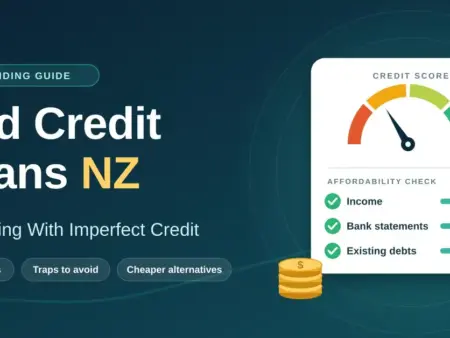
A bad-credit loan is a personal loan for someone whose credit score sits below what mainstream banks accept (roughly under 500 on Equifax’s 0–1,000 scale). NZ credit is tracked by three bureaus — Equifax, Centrix and illion — and around one in five New Zealanders has some adverse listing. Instead of an automatic decline, these lenders take a more holistic view, weighing:
Amounts typically run from about $500 to $20,000–$30,000 (secured), over 3 months to 5 years, at higher rates than standard loans — often 19.99% to 49.95% p.a. Always ask for the total cost of credit in dollars, not just the rate.
Other options worth considering include a bank overdraft or an existing credit card (both cheaper than payday loans), a small loan from family or friends (put any agreement in writing), or selling unwanted items via Trade Me or Facebook Marketplace to raise cash without borrowing at all. And building even a small emergency fund is the surest way to avoid needing high-cost credit next time.
When a payday loan might make sense — and when not
A payday loan may occasionally be justifiable if the expense is genuinely urgent, you’ve checked the cheaper options and none are available in time, and you’re confident you can repay comfortably and quickly. It’s the wrong choice if you can’t afford the repayments without strain, you need longer-term or larger finance, you’re already behind on other bills, or you find yourself relying on these loans regularly — that last one is a clear sign to seek free budgeting help rather than borrow again.
The bottom line
Payday loans deliver speed and accessibility, but at a cost that can reach as much as the loan itself in interest and fees, and with a real risk of a debt spiral for people already stretched. New Zealand’s caps limit the worst harm, but they don’t make these loans cheap. If you’re facing a shortfall, start with Work and Income, a no-interest community loan, a conversation with who you owe, or free help from MoneyTalks on 0800 345 123 — and keep a payday loan as a genuine last resort, borrowing only what you need with a clear plan to repay.
Disclaimer: This article is general information about payday and high-cost loans in New Zealand, not financial advice, and not a recommendation of any lender or product. Costs, caps and rules change — confirm current details before borrowing, and read any contract carefully. Payday loans are high-cost and carry a real risk of financial harm; if money is a struggle, free, confidential help is available from MoneyTalks on 0800 345 123 (moneytalks.co.nz), and Community Law offers free legal advice.
Check these before a commercial bad-credit loan
Work and Income (if you’re on a benefit)
You may qualify for an advance, a Special Needs Grant (for essentials, sometimes not repaid), or interest-free recoverable assistance — check this first before any high-interest lender.
No- and low-interest community loans
Good Shepherd NZ offers No Interest Loans and low-interest StepUP loans for people on low incomes — no good credit score needed. Credit unions also lend far cheaper than bad-credit lenders.
Talk to your existing creditors
Under the CCCFA you can apply for hardship on loans you already have — extended terms, reduced payments or a payment holiday, which the lender must genuinely consider.
Frequently asked questions
What is a payday loan?
A short-term, high-cost loan — usually $100 to $2,000 — designed to be repaid over a few weeks, often on your next payday. Lenders work online, approve quickly, and will often lend to people with poor credit, but they’re the most expensive way to borrow.
How much do payday loans cost in NZ?
By law, interest is capped at 0.8% a day (about 292% a year), and the total cost of credit — interest plus all fees — can’t exceed the amount you borrowed. So a $500 loan can still legally cost up to $500 more on top over its life. For a month, that’s typically $60–$120+ — far more than other options.
Are payday loans legal in NZ?
Yes, but they’re tightly regulated under the CCCFA (overseen by the FMA from 1 July 2026). Lenders must be registered, belong to a dispute resolution scheme, assess whether you can repay without hardship, disclose all costs, and offer hardship options.
Can I get a payday loan with bad credit?
Often, yes — many payday lenders focus on your current income and spending rather than your credit score, so past defaults aren’t always a barrier. But lenders must still check affordability by law, so “no credit check” loans are rare, and being approved doesn’t mean it’s a good idea.
What are the alternatives to a payday loan?
Much cheaper options include Work and Income assistance (advances, grants, interest-free help), no- or low-interest community loans (Good Shepherd NZ, credit unions), a bank overdraft or credit card, a payment plan with who you owe, or borrowing from family. Free help from MoneyTalks (0800 345 123) can find options you haven’t considered.
What should I do if I’m struggling with payday loan debt?
Contact the lender to ask for a hardship arrangement, stop borrowing more, and get free help. MoneyTalks (0800 345 123) offers confidential financial mentoring, Community Law offers free legal advice, and under the CCCFA the lender must genuinely consider a hardship application.