Use our NZ PAYE calculator guide to understand your 2025/26 take-home pay. Covers income tax brackets, ACC levy, KiwiSaver, student loans, tax codes, and GST.

PAYE in New Zealand 2026/27: How It Works, Tax Codes and Deductions

Open your payslip and the gap between your gross pay and what actually lands in your bank account can be a surprise. In New Zealand almost all of that gap is handled by PAYE — short for Pay As You Earn — the system your employer uses to deduct tax and a few other amounts before paying you. This guide explains exactly what comes out of your pay in the 2026/27 tax year (1 April 2026 to 31 March 2027), how to make sure your tax code is right, and the small mistakes that quietly cost people hundreds of dollars a year. It is general information, not personal tax advice. To see your own take-home figure, run the numbers through our salary calculator.
How PAYE works in New Zealand
PAYE is the method Inland Revenue (IRD) uses to collect income tax from employees across the year, rather than in one lump sum at the end. Each pay run, your employer works out the tax and other deductions owing on your earnings, takes them out, and passes them to IRD on your behalf. Because the tax is collected as you earn, most salaried employees never have to file a tax return — IRD squares everything up automatically after the tax year ends.
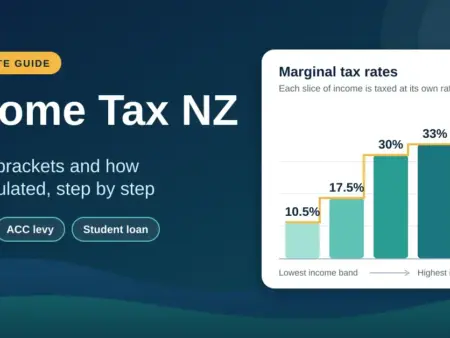
The income tax part is progressive, and this is the single most misunderstood thing about it. Your income is taxed in slices, and only the portion that falls inside each bracket is taxed at that bracket’s rate — never your whole salary. Earning one dollar more and tipping into a higher bracket only taxes that extra dollar at the higher rate; it does not reprice everything you earned below it. So a pay rise always leaves you better off, even if it nudges you into the next band.
Key points
- PAYE is how Inland Revenue collects tax from employees — your employer deducts it before you’re paid.
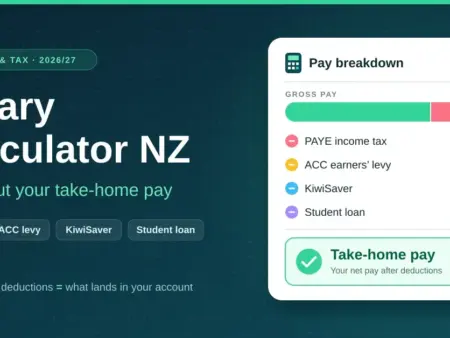
- Up to four things come out through PAYE: income tax, the ACC earners’ levy, KiwiSaver and student loan repayments.
- Income tax is progressive — only the income inside each bracket is taxed at that bracket’s rate, never your whole salary.
- Two amounts rose in 2026: the KiwiSaver default rate (to 3.5%) and the ACC levy (to 1.75%).
- Your tax code controls how much is withheld — the single biggest thing to get right.
- All figures here are for the 2026/27 tax year (1 April 2026 to 31 March 2027).
What comes out of your pay
For most employees, up to four separate amounts flow through PAYE each pay run. Two of them changed in 2026, so it is worth checking your payslip against the current figures.
Quick facts
| Item | 2026/27 figure |
|---|---|
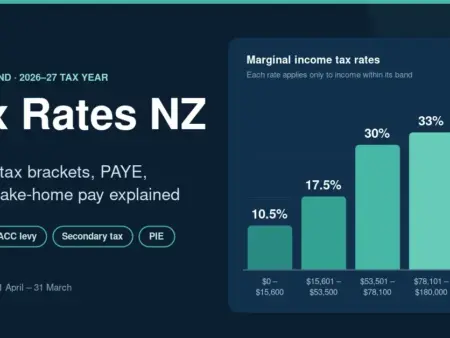
| Income tax brackets | 10.5% to $15,600; 17.5% to $53,500; 30% to $78,100; 33% to $180,000; 39% above |
| ACC earners’ levy | 1.75% on income up to $156,641 (max about $2,741) |
| KiwiSaver default rate | 3.5% employee, matched by 3.5% employer (from 1 April 2026) |
| KiwiSaver government contribution | Up to $260.72 a year (contribute $1,042.86; income under $180,000) |
| Student loan repayment | 12% of income above $24,128 (about $464 a week) |
| Independent Earner Tax Credit | Up to $520 a year (income $24,000–$70,000) |
| No-declaration tax rate | 45% if no IRD number or tax code is given |
| GST (self-employed) | 15%; registration required at $60,000 turnover |
Income tax
Income tax is the largest deduction for most people. For 2026/27 the brackets are unchanged from the previous year: 10.5% on income up to $15,600, 17.5% up to $53,500, 30% up to $78,100, 33% up to $180,000, and 39% on anything above that. There is no tax-free threshold in New Zealand — the first dollar you earn is taxed at 10.5%.
Here is how the slices work in practice. On a $70,000 salary you do not pay 30% on the lot. You pay 10.5% on the first $15,600, 17.5% on the next $37,900, and 30% only on the remaining $16,500 — an income tax bill of about $13,220. That is an effective rate of roughly 18.9%, well under the 30% top slice. Our New Zealand income tax guide breaks the brackets down in full.
The ACC earners’ levy
The ACC earners’ levy funds cover for injuries that happen away from work — at home, playing sport or out on the road — through New Zealand’s no-fault accident scheme. It is deducted through PAYE alongside your tax. For 2026/27 the rate rose to 1.75% (up from 1.67%) on earnings up to a cap of $156,641, so the most anyone pays is about $2,741 for the year. You can read how the levy is set on acc.co.nz.
KiwiSaver
If you are enrolled in KiwiSaver, your contributions come out through PAYE too. From 1 April 2026 the default employee rate rose from 3% to 3.5%, and your employer must match it at 3.5% (a further step up to 4% has been deferred to 2028). You can still choose 3%, 4%, 6%, 8% or 10% for your own share. Separately, the government tops up your savings with a contribution of up to $260.72 a year — halved from $521.43 in July 2025 — paid at 25 cents for every dollar you put in, so you need to contribute at least $1,042.86 across the year to get the full amount. People earning over $180,000 no longer qualify for it, and from 2026 16- and 17-year-olds became eligible for employer and government contributions. IRD explains the top-up at ird.govt.nz, and our guide to choosing a KiwiSaver fund covers where that money goes.
Student loan repayments
If you are New Zealand-based with a student loan, repayments are deducted automatically once your income passes the threshold. For 2026/27 that is 12% of every dollar you earn above $24,128 a year (about $464 a week), triggered by the SL suffix on your tax code. New Zealand-based loans are interest-free, and you can make voluntary payments straight to IRD to clear yours faster. If your income drops below the threshold — on parental leave, say — you may be able to reduce or pause deductions. Overseas-based borrowers follow a different, balance-based system that is not collected through PAYE. IRD sets out the rules for repaying through salary or wages.
Getting your tax code right
Your tax code tells your employer how much to withhold. Getting it wrong is one of the most common reasons people end up with a surprise bill — or a needless overpayment — when IRD reconciles the year. You declare your code on an IR330 form when you start a job, and you can update it any time your situation changes. IRD’s full list of codes is on ird.govt.nz.
Your main job: M, ME and SL
Use M for your main or only source of income. Use ME instead if you earn between $24,000 and $70,000 from that job and don’t receive Working for Families or NZ Super — the “E” captures the Independent Earner Tax Credit (IETC), worth up to $520 a year ($10 a week). The credit is paid in full up to $66,000 and then abates by 13 cents for every dollar you earn above that, disappearing at $70,000. Add the SL suffix to whichever code you use if you have a student loan — so a typical graduate on one job is on “M SL”.
Secondary tax codes for a second job
Income from a second job or second source is taxed with a secondary code, not another M. The right one depends on where your total income across all jobs sits: SB (under $15,600), S ($15,601–$53,500), SH ($53,501–$78,100), ST ($78,101–$180,000) or SA (over $180,000). The idea is that your second income is taxed at the rate for the band it actually lands in once it is stacked on top of your main pay.
If you don’t hand in a tax code
If you don’t give your employer an IR330 with your IRD number and code, they must deduct at the no-notification rate of 45% on every dollar. It is a safeguard against under-taxing, and any overpayment comes back after your end-of-year assessment — but it is a lot to have withheld in the meantime, so it pays to file the form promptly.
A worked take-home example
Putting it together for someone earning $75,000 on the M SL code in 2026/27: income tax is about $14,720, the ACC levy about $1,313 (1.75%), KiwiSaver $2,625 (3.5%), and student loan about $6,105 (12% of income above $24,128). That leaves roughly $50,200 a year — about $1,930 a fortnight in the hand. These are illustrative; your exact figure depends on other income, tax credits and your precise code. To see how your pay compares, read our guides to the average salary in New Zealand and the current minimum wage.
Common PAYE mistakes to avoid
Most PAYE problems come down to a handful of avoidable slip-ups:
- Staying on M when you qualify for ME. If you’re eligible for the IETC and don’t use ME, you miss up to $520 a year.
- Forgetting the SL suffix (or leaving it on after your loan is repaid), so repayments are either missed or over-deducted.
- Using M on a second job. Two “main” codes under-tax you, and IRD claws the shortfall back later.
- Assuming a higher bracket taxes your whole income. It doesn’t — only the slice inside that band.
- Not reading your end-of-year assessment. IRD’s automatic calculation can produce a refund or a bill; it’s worth checking.
- Leaving an old code in place after a pay rise, a second job ending, or finishing study.
PAYE vs GST: what the self-employed pay instead
PAYE covers employment income. If you’re self-employed or run a business you generally won’t have PAYE deducted; instead you pay your income tax directly (often in instalments called provisional tax), and the other main tax you deal with is GST — a flat 15% on almost all goods and services. You must register for GST once your turnover passes $60,000 in any 12-month period, though registering voluntarily below that can pay off if you have GST on expenses to claim back. To add GST, multiply by 1.15; to find the GST inside a GST-inclusive price, divide by 1.15. Our GST calculator guide walks through it, and business.govt.nz has the registration and filing rules.
The banking backdrop to your pay
Once PAYE has done its work, your take-home pay lands in a bank account, so it is worth knowing the system that protects and regulates it. Eligible bank deposits are now covered by the Reserve Bank’s Depositor Compensation Scheme (rbnz.govt.nz/dcs), while responsibility for regulating consumer credit has moved from the Commerce Commission (comcom.govt.nz) to the Financial Markets Authority (fma.govt.nz). The sector keeps changing, too: Canstar named TSB its 2026 Bank of the Year for everyday banking (canstar.co.nz), TSB sets out its community-trust history on its own site (tsb.co.nz/about/our-story; background also on en.wikipedia.org), and Heartland has proposed a merger with TSB (heartland.co.nz/tsb-merger), announced to the market (nzx.com) and reported widely (nzherald.co.nz). Banks have also faced scrutiny on lending conduct, with several admitting responsible-lending breaches (stuff.co.nz) and TSB drawing a High Court penalty over overcharges (thelawyermag.com).
Your next steps
Getting your PAYE settings right is one of the simplest high-impact money moves there is, and it takes only minutes. Confirm your tax code with IRD, switch to ME if you’re eligible for the IETC, check the SL suffix is there (and only there) if you have a student loan, and make sure your KiwiSaver rate suits your budget. On a second job, pick the secondary code that matches your total income. Small adjustments like these can add up to hundreds — sometimes thousands — of dollars over a year.
Disclaimer: This article is general information about PAYE in New Zealand, not tax advice. Tax rates, thresholds, the ACC levy, KiwiSaver settings and the student loan threshold all change — the figures here are for the 2026/27 tax year (1 April 2026 to 31 March 2027) and should be confirmed with Inland Revenue before you rely on them. For your own tax code and obligations, check with IRD or talk to a chartered accountant.
Sources
- Inland Revenue — Tax codes and tax rates for individuals
- Inland Revenue — Independent earner tax credit (IETC)
- Inland Revenue — Repaying my student loan from salary or wages
- Inland Revenue — Getting the KiwiSaver government contribution
- ACC — Understanding levies if you work or own a business
- business.govt.nz — GST basics
Frequently asked questions
What is PAYE in New Zealand?
Pay As You Earn is how Inland Revenue collects income tax from employees. Your employer deducts income tax — plus the ACC earners’ levy, KiwiSaver and any student loan repayments — from each pay and sends it to IRD, so most salaried employees never have to file a tax return.
What are the income tax brackets for 2026/27?
10.5% on income up to $15,600, 17.5% up to $53,500, 30% up to $78,100, 33% up to $180,000, and 39% above that. The system is progressive, so only the income within each band is taxed at that band’s rate. The brackets are unchanged from 2025/26.
What is deducted from my pay besides income tax?
The ACC earners’ levy (1.75% of earnings up to $156,641 in 2026/27), KiwiSaver if you’re enrolled (default 3.5% from 1 April 2026, matched by your employer), and student loan repayments if you have one (12% of income above $24,128, via the SL code).
How do I know which tax code to use?
Use M for your main job, or ME if you’re eligible for the Independent Earner Tax Credit, and add SL if you have a student loan. For a second job use a secondary code (SB, S, SH, ST or SA) that matches your total income. If you don’t give your employer an IRD number and code, tax is deducted at 45%.
What is the student loan repayment threshold?
For 2026/27 it’s $24,128 a year (about $464 a week). You repay 12% of every dollar earned above it through PAYE when your code includes the SL suffix. New Zealand-based loans are interest-free, and you can make voluntary repayments to clear yours sooner.
No comments to show.
Best Brokers

Get approved fast with Finance Now. Personal loans, car finance & retail purchases – made easy for everyday Kiwis.

Shop now, pay later with Farmers Finance. Flexible payment options at Farmers stores across NZ – online and in-store.