Everything NZ first home buyers need to know: KiwiSaver first home withdrawal, the First Home Loan scheme, LVR and DTI rules, deposit strategies, and how to choose the right mortgage structure.

First Home Buyer NZ: The Complete 2026 Guide

Buying your first home in New Zealand is one of the biggest financial steps you’ll take — and the schemes, lending rules and deposit requirements that shape it change often. Whether you’re setting aside your first pay packet or already sitting at the pre-approval stage, this guide maps the whole journey: building a deposit, your KiwiSaver first-home withdrawal, the Kāinga Ora First Home Loan, the Reserve Bank’s LVR and DTI limits, how to structure a mortgage, and the buying process itself. It’s general information rather than personal financial advice, and because scheme settings change, always confirm the current rules with the official source before you rely on them.
The deposit foundation banks want to see
Before a lender hands over several hundred thousand dollars, they want solid evidence you’re a low-risk borrower — and that means more than a steady salary. Most banks look for at least 5% in genuine savings: money you have accumulated yourself over time rather than a sudden windfall or gift. KiwiSaver balances generally count as genuine savings, which is one reason the scheme sits at the centre of most first-home deposits.
What matters just as much as the amount is a consistent savings habit. Regular automatic transfers into a dedicated account tell a far more convincing story than a large lump sum that lands three weeks before you apply. In the months before you apply, take three practical steps:
- Tidy up your credit. Pull a free credit report from Centrix or Equifax three to six months early so you have time to correct any errors or settle overdue accounts. Our guide to what makes a good credit score in NZ explains exactly what lenders look for.
- Read your bank statements like a lender would. Frequent buy-now-pay-later, gambling or takeaway charges all raise questions, so trim unnecessary subscriptions and avoid taking on new debt — including car finance.
- Stress-test your own budget. Banks assess your ability to repay at an interest rate 2–3 percentage points above the actual rate; you can run the same exercise with our home loan calculator.
Key points
- Genuine deposit: most banks want at least 5% in savings you’ve built yourself; a 20% deposit unlocks the best rates.
- KiwiSaver: after three years’ membership you can withdraw all but $1,000 toward your first home.
- First Home Loan: buy with a 5% deposit through a participating bank, subject to income caps.
- First Home Grant: closed to new applications on 22 May 2024 — no cash grant now applies.
- Lending limits: owner-occupiers are generally capped at about six times income (DTI), and banks limit low-deposit lending (LVR).
- Get help: a registered mortgage adviser usually costs you nothing and compares multiple lenders.
How debt-to-income (DTI) limits affect you
Since mid-2024 the Reserve Bank has applied debt-to-income (DTI) restrictions alongside deposit rules. For owner-occupiers, banks can place no more than 20% of their new lending above a DTI of six — so in practice most buyers are capped at total borrowing of around six times gross household income. A household earning $120,000 could therefore borrow up to roughly $720,000, although individual banks often set tighter internal limits.
Because every existing commitment eats into that capacity, clear high-interest debt first (credit cards and personal loans reduce your borrowing power dollar for dollar), avoid new commitments in the six months before you apply, and get advice before folding other debts into a mortgage. First home buyers are generally the least affected group — the Reserve Bank designed the DTI rules to avoid shutting them out, and the restrictions let it keep deposit (LVR) rules looser than they would otherwise be. You can read the detail on the Reserve Bank's macroprudential policy pages.
Using your KiwiSaver first-home withdrawal
For most New Zealanders the KiwiSaver first-home withdrawal is the single biggest lever on their deposit. If you qualify, you can withdraw almost your entire balance — your own contributions, your employer’s contributions, the Government contribution and all the investment returns earned since you joined — leaving just $1,000 in the account.
To be eligible you generally must:
- have been a KiwiSaver member for at least three years (the years don’t need to be continuous);
- be buying your first home, or hold a Kāinga Ora “second chance” determination;
- intend to live in the property — KiwiSaver can’t be used for an investment purchase;
- be buying a property located in New Zealand.
The money is paid directly to your solicitor shortly before settlement, not to you, so start the application with your provider four to six weeks ahead of the settlement date.
Two recent changes are worth knowing. From 1 July 2025 the annual Government contribution was halved to 25 cents for every dollar you contribute, up to a maximum of $260.72 a year (you need to put in about $1,043 yourself to receive the full amount), and members earning over $180,000 no longer receive it. Separately, the default contribution rate rises to 3.5% of pay from 1 April 2026 (and to 4% from April 2028), which gradually speeds up how fast your balance — and your future deposit — grows. For the wider picture, see our KiwiSaver guide and the step-by-step first-home withdrawal guide.
The Kāinga Ora First Home Loan (5% deposit)
If you can’t reach a 20% deposit, the Kāinga Ora First Home Loan is the main government-backed route into the market. Kāinga Ora underwrites the loan while a participating bank or lender actually issues it, letting eligible buyers purchase with a deposit of as little as 5%.
Current eligibility centres on income caps that have been in place since 2022: a single buyer with no dependants must earn $95,000 or less, while two or more buyers combined — or a single buyer with dependants — must earn $150,000 or less. There’s a one-off insurance premium of around 1.2% of the loan, which can usually be added to the mortgage, and First Home Loans are exempt from the LVR and DTI speed limits (the bank still runs its own credit and servicing checks). A “second chance” provision can help previous homeowners who are now in much the same financial position as a first-time buyer.
Scheme settings are reviewed periodically, and the 5% deposit scheme has become a live political issue — during the 2026 election campaign the National Party proposed lifting the income cap to $300,000, so the thresholds above could change depending on policy decisions. Always confirm the current rules at kaingaora.govt.nz before you make an offer.
Comparison
| Feature | Standard bank loan | Kāinga Ora First Home Loan |
|---|---|---|
| Minimum deposit | Typically 10–20% | 5% |
| Income limits | None (based on serviceability) | $95k single / $150k with dependants or two or more buyers |
| Low-deposit cost | Low-equity margin (ongoing rate premium) | One-off insurance premium (~1.2%, can be added to the loan) |
| LVR / DTI speed limits | Apply | Exempt (bank still runs its own checks) |
| House price caps | None | National caps removed in 2022; situational limits may apply |
| Who issues it | The bank | A participating bank, underwritten by Kāinga Ora |
The First Home Grant has closed
It’s important to be clear on one point: the First Home Grant — the subsidy of up to $10,000 for a new build or $5,000 for an existing home — closed to new applications at 1pm on 22 May 2024, with the funding redirected to build around 1,500 social homes. If you held a valid pre-approval or had signed a sale and purchase agreement before that date you may still have been eligible, but the grant is otherwise gone and no cash replacement has been introduced.
The closure doesn’t change KiwiSaver’s role, though — your withdrawal balance, built from your pay, your employer’s contributions, the Government contribution and investment returns, remains one of the most powerful deposit tools available. It’s also worth asking your local council, iwi or a community housing provider about regional assistance, particularly outside the main centres.
LVR rules and low-deposit lending
The Reserve Bank’s loan-to-value ratio (LVR) restrictions cap how much low-deposit lending banks can do. From 1 December 2025, banks can lend up to 25% of their new owner-occupier lending to borrowers with less than a 20% deposit (an LVR above 80%) — an easing from the previous 20% limit, made possible because the DTI rules now do some of the heavy lifting.
In practice, most first home buyers still aim for a 20% deposit where they can, for two reasons: it unlocks the sharpest advertised interest rates, and it avoids a low-equity margin — a premium of roughly 0.25% to 1.5% that banks add to the rate on loans above 80% LVR. But banks do approve low-deposit applications, especially for applicants with strong, stable incomes and clean credit, and the First Home Loan exists precisely for buyers who can’t reach 20%.
Choosing your mortgage structure
New Zealand borrowers overwhelmingly prefer fixed rates. Fixing locks your rate for a set term — commonly six months to five years — giving certainty over repayments, while a floating rate is usually higher but lets you make extra repayments or repay in full without a break fee.
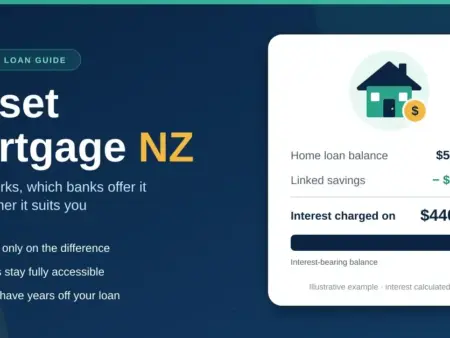
Most advisers suggest a split structure for first home buyers: fix the bulk of the loan for certainty and leave a smaller slice floating (or as revolving credit) so you can throw lump sums at it whenever you have spare cash. An offset account links your savings to your loan so you pay interest only on the net balance — owe $500,000, hold $30,000 in the linked account, and you’re charged interest on $470,000. Revolving credit works like a large secured overdraft. Both reward disciplined savers and do little for people who tend to spend whatever is available.
On term, most loans run 25 to 30 years. A longer term lowers the minimum repayment but sharply increases the total interest you pay, so pay above the minimum from day one where you can — even an extra $50 a week on a $500,000 loan can cut years off the term and save tens of thousands in interest. For the full mortgage picture see our home loans guide, and model repayments with the ANZ home loan calculator.
Mortgage adviser or go direct?
New Zealand has a well-developed mortgage adviser (broker) industry, and for first home buyers using one often makes sense. A registered adviser can compare products across many lenders — including non-bank lenders such as Pepper Money or Liberty Financial — and structure your application to give it the best chance of approval. Advisers are generally paid a commission by the lender on settlement, so there’s usually no direct cost to you, though not every adviser works with every lender, so ask which ones they can access.
Going direct to your own bank can work well if you already have a strong relationship and a clean financial profile. The trade-off is that a single bank will only ever show you its own products, so you lose the comparison an adviser provides.
The home-buying process, step by step
Once your deposit and finances are in order, the purchase itself follows a fairly predictable path:
- Set your budget. Work out what you can comfortably repay — not just what a bank will lend — using a budget planner.
- Get pre-approval. A conditional approval tells you your price range and shows agents you’re a serious buyer.
- Apply to withdraw your KiwiSaver once you’re close to buying, so the funds are ready in time for settlement.
- House-hunt and do your due diligence. Order a LIM report from the council and, for most homes, a builder’s inspection before you commit.
- Make an offer. Most offers are made conditional on finance, a satisfactory LIM and builder’s report, and sometimes a registered valuation.
- Appoint a solicitor or conveyancer to review the sale and purchase agreement and the title, and to handle settlement.
- Go unconditional once every condition is met, then arrange house insurance — your lender will require it from settlement day.
- Settle — your solicitor transfers the funds, including your KiwiSaver withdrawal, and you collect the keys.
Independent tools can help at every stage: the Retirement Commission’s Sorted mortgage calculator and the impartial guides at Consumer NZ are good places to start.
Common mistakes to avoid
- Leaving your credit check too late. Errors can take weeks to fix, so check early.
- Taking on new debt before applying. A new car loan or credit card right before an application can sink it.
- Forgetting the $1,000 minimum that must stay in your KiwiSaver account after a first-home withdrawal.
- Underestimating the extra costs — legal fees, the LIM, a builder’s report, insurance, moving and maintenance all add up on top of the deposit.
- Borrowing to your absolute maximum, which leaves no cushion for rate rises or a drop in income.
- Switching jobs just before applying, which can unsettle a lender assessing the stability of your income.
Where you buy matters
Median house prices vary enormously across New Zealand, so where you buy can decide whether you get in at all. A regional centre rather than a main city can mean a smaller deposit, a more manageable mortgage and an earlier entry into the market — sometimes worth more than holding out for a specific suburb. Weigh it against commute, work and lifestyle, but keep an open mind about location while you’re still saving.
Disclaimer: This article is general information for first home buyers in New Zealand, not personal financial advice. Scheme settings — KiwiSaver rules, the First Home Loan’s income caps and premium, and the Reserve Bank’s LVR and DTI limits — change and depend on your circumstances, and some figures here are indicative for 2026. Always confirm the current rules directly with Kāinga Ora (kaingaora.govt.nz), your KiwiSaver provider and your lender before relying on them, and consider advice from a registered mortgage adviser.
Sources
- Kāinga Ora — First Home Loan (5% deposit, income caps, current settings)
- Reserve Bank of New Zealand — macroprudential (LVR and DTI) policy
- Sorted (Te Ara Ahunga Ora Retirement Commission) — mortgage calculator
- Consumer NZ — home loans and buying a home
- Kāinga Ora — First Home Grant (closed 22 May 2024)
- Budget 2025 — KiwiSaver changes factsheet
Frequently asked questions
How much deposit do I need to buy my first home in NZ?
Most lenders want 20% for the sharpest rates, but there are lower-deposit routes. The Kāinga Ora First Home Loan lets eligible buyers in with just 5%, and banks can do a limited share of low-deposit lending (usually with a low-equity margin added to the rate). Your KiwiSaver first-home withdrawal can make up much of whatever deposit you do need.
Can I use my KiwiSaver to buy my first home?
Yes. If you’ve been a member for at least three years and have never owned property (or hold Kāinga Ora second-chance approval), you can withdraw almost your whole balance — including employer and Government contributions and investment returns — leaving a minimum of $1,000. The funds go directly to your solicitor on settlement, so apply four to six weeks ahead.
What is the Kāinga Ora First Home Loan?
It’s a government-backed scheme that lets eligible first home buyers purchase with a 5% deposit through a participating bank, with Kāinga Ora underwriting the loan. Income caps apply ($95,000 for a single buyer, or $150,000 for two or more buyers or a single buyer with dependants), and there’s a one-off insurance premium of around 1.2% that can be added to the loan. Confirm the current settings with Kāinga Ora.
Is the First Home Grant still available?
No. The First Home Grant closed to new applications on 22 May 2024 and no cash-grant replacement has been introduced. First home buyers should focus on the KiwiSaver first-home withdrawal and the Kāinga Ora First Home Loan instead.
What are the current LVR and DTI rules for first home buyers?
From 1 December 2025, banks can lend up to 25% of their owner-occupier lending to borrowers with under a 20% deposit, and DTI caps limit most owner-occupiers to about six times gross income. Importantly, Kāinga Ora First Home Loans are exempt from both speed limits, though the bank still runs its own credit and servicing checks.
No comments to show.
Best Brokers

Get approved fast with Finance Now. Personal loans, car finance & retail purchases – made easy for everyday Kiwis.

Shop now, pay later with Farmers Finance. Flexible payment options at Farmers stores across NZ – online and in-store.